By Atif Balouch, director of photography, Dubai
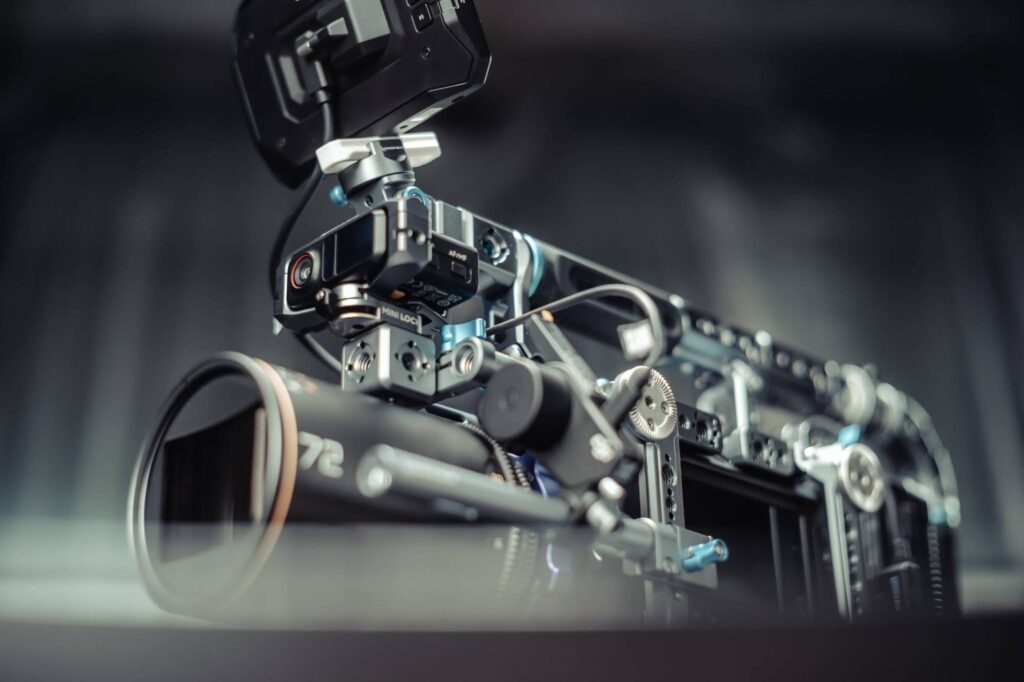
Industry-standard cinema cameras such as the ARRI Alexa Mini and Sony VENICE carry high purchase and rental rates. Cheaper alternatives usually cost the filmmaker some dynamic range or sensor size. Workflow options are often limited as well.
The Blackmagic PYXIS 12K was launched at $4,995 for the body, and retailers currently sell it for around $5,800. At that price, it competes with cameras that cost several times more. I own a PYXIS 12K and shoot with it as part of my camera packages in Dubai. It has been tested on my commercial sets and on narrative shoots, and the sections below describe the results.
Design and Monitoring
Three mount versions are available: L, PL and EF. The modular box design comes from the PYXIS 6K, so the camera is easy to rig for studio builds or gimbal work. Handheld configurations are also straightforward.
Power consumption is low. A Gold Mount or V-Mount plate can be added for longer runtimes and extra power outputs, although the camera runs well on standard Sony-style batteries in the rear slot. Footage is recorded to CFexpress Type B cards, which are fast enough for the high data rates of 12K Blackmagic RAW.
Monitoring is where the PYXIS 12K is most useful on set. There is only one SDI output. Even so, up to three independent monitoring feeds can run at the same time, because the front and rear USB-C ports work alongside the SDI out. Overlays are configured separately for each display. On my shoots, LUTs and focus peaking stay on my own EVF or touchscreen, while a clean feed goes to the client monitor or DIT station.
The RGBW Sensor and Full-Width Scaling
The camera uses Blackmagic’s new RGBW full-frame sensor. Many sensors crop the image when the recording resolution is lowered, whereas the PYXIS 12K scales across the full sensor width:
- 12K (full-frame 3:2 open gate) and 9K (Super 35): Both modes use the same sensor circuitry and give identical dynamic range and latitude.
- 8K and 4K: These modes keep the same field of view as 12K. Lens choices and framing therefore stay the same at every resolution.
Dynamic Range Compared with the ARRI Alexa Mini
I compared the PYXIS 12K directly with an ARRI Alexa Mini. The results were close, and in some areas the PYXIS performed better.
Blackmagic’s dynamic range charts show how the ISO setting moves the balance between highlight and shadow protection:
- 1000–2000 ISO (12K/9K): The range is split roughly 7 stops over and 7 stops under, which matches the Alexa Mini. Highlights recover well in DaVinci Resolve.
- 125 ISO (8K/4K): Most of the range moves toward the shadows, with roughly 13 stops under. Blacks stay very clean.
At 300% to 400% magnification, the deep shadows from the PYXIS 12K showed a cleaner noise floor than those from the Alexa Mini. This matters to colourists and DPs. Less sensor noise has to be handled in the grade, so film grain emulation can be added in post-production on a clean base.
Rolling Shutter and Flicker-Free Slow Motion
Rolling shutter is a common weakness of high-resolution full-frame sensors. On the PYXIS, the 12K full-frame readout is moderate, and Blackmagic offers two practical ways to reduce it:
- Switch to 9K Super 35: When the focal length is matched for Super 35 (a 65mm in place of a 105mm, for example), the readout is roughly 6.5 milliseconds faster. The latitude curve stays the same.
- Use 8K mode: For sport or whip-pans, 8K gives fast rolling shutter performance and frame rates up to 112 fps.
Practical lights can flicker at high frame rates, and the PYXIS 12K handles this well. When an off-speed frame rate such as 70 fps or 96 fps is selected, the camera calculates suitable shutter angles and suggests them on screen. Less time is spent on playback tests as a result.
Drawbacks to Consider
The camera has some compromises, although they are small for the price:
- Autofocus depends on firmware: When I tested the camera, continuous autofocus for L-Mount lenses was still waiting for a firmware update. Blackmagic has been improving autofocus through updates. If your work relies on AF, check the current firmware before the shoot.
- Internal recording is BRAW only: Blackmagic RAW grades very well in DaVinci Resolve, and compression ratios go up to 18:1. However, there is no lighter 10-bit 4:2:2 codec such as Sony’s XAVC-I. File sizes are larger as a result, and clients or post houses must be able to work with BRAW.
Verdict
Blackmagic’s 12K sensor architecture is already used on major studio productions. The PYXIS 12K places the same image pipeline in a body that launched at $4,995. In my side-by-side narrative tests, PYXIS footage intercut with Sony VENICE footage without visible differences, and experienced cinematographers would find it hard to tell the two apart.
The camera works as a compact A-cam for commercial productions. It can also serve as a B-cam next to high-end cinema packages, or as an affordable entry into open-gate 12K filmmaking. To summarise, the PYXIS 12K offers a strong balance between price and image quality, and it has been reliable on my sets.
If you are planning a shoot in Dubai or the UAE and would like the PYXIS 12K on set with a director of photography, see my equipment list or contact me.