By Atif Balouch, director of photography, Dubai
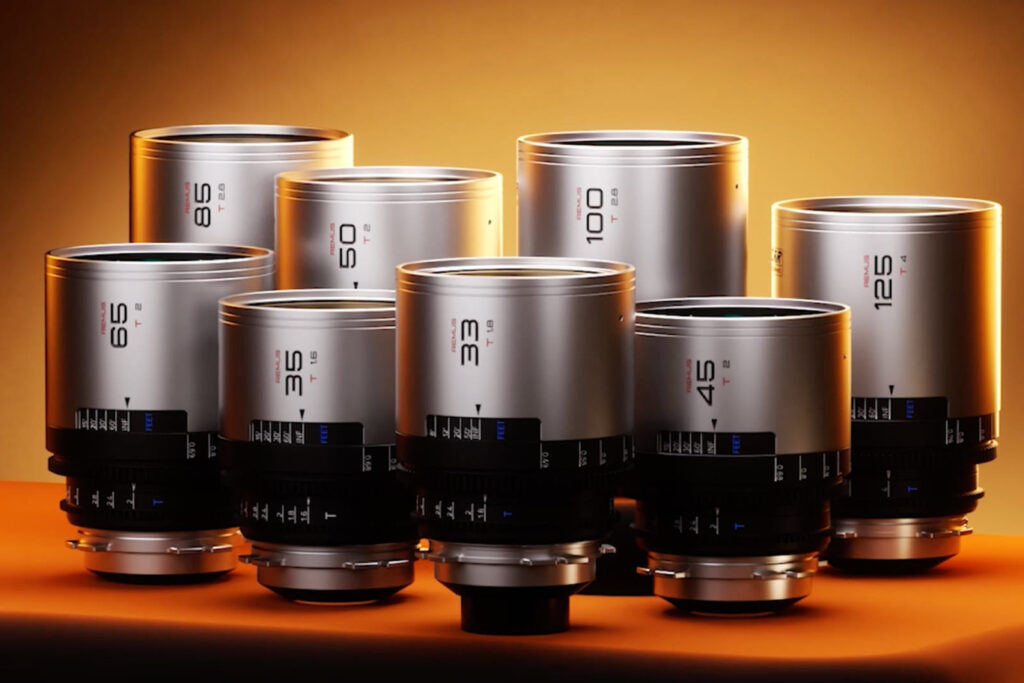
Blazar Remus 1.5x lineup. Image: Blazar
The Blazar Remus anamorphic lenses sell for around $749 to $999 each. At that price they give genuine anamorphic character for a fraction of the cost of traditional cinema glass, which explains their popularity with independent filmmakers.
I bought the full Remus set (33mm to 125mm, amber flare) with my own money, and I use it on paid shoots as a director of photography in Dubai. This review covers what the lenses do well and where they are limited. It also explains how I handle those limits on set. The final section compares the Remus on paper with its closest new competitor, the DZOFilm Arcana 1.5x.
Strengths of the Blazar Remus
Several practical features explain why the lineup is common among solo shooters and independent DPs.
1. Size and Weight for Solo Operators
Traditional cinema anamorphics such as the Atlas Orion and Laowa Proteus are large and heavy. They are designed for full camera crews and studio builds. Each Remus weighs around 716–880 g (about 1.6–1.9 lb), with the exact figure set by the focal length. The lens balances easily on a gimbal, and on a light mirrorless rig it still feels like a real cinema lens.
2. A 1.5x Squeeze Factor
Hollywood productions usually choose a 2x squeeze for 4:3 or 3:2 sensors. The Remus uses a 1.5x squeeze. On 16:9 or 17:9 recording modes this gives a wide aspect ratio that does not become too narrow, and the lenses also work well on open-gate full-frame cameras.
Blazar sells amber and blue flare versions. A silver flare version with a more neutral look is also available.
3. A 150-Degree Focus Throw
On a large set, a 1st AC usually prefers a focus throw of 270° to 310° for fine adjustments. The Remus has a shorter 150-degree throw. With a full crew this can feel tight. For a solo operator who pulls focus by hand or with a compact follow focus, it is an advantage, and it also helps when the lens is balanced on a gimbal.
Limitations to Plan For
The low price makes it easy to forgive the optical quirks of the Remus. On a paid shoot, however, they need to be known in advance. The notes below describe how I handle each one.
1. Softness at T2: Shoot at T2.8 to T4
A T2 aperture looks attractive for low light and shallow depth of field. In practice, the Remus shows heavy chromatic aberration at T2, and the image is very soft. The effect resembles a half-stop Black Pro-Mist placed over an already soft vintage lens. Some projects can use that as a look, although the image is far from clean.
- Where I shoot them: The lens becomes sharp enough at T2.8. The best balance of character and sharpness sits between T2.8 and T4, and that is the range I use on paid jobs.
- Maximum sharpness: The cleanest image comes at T5.6. Lighting should be planned so that there is no need to open to T2.
2. Minimum Focus Distance and Focus Accuracy
The original Remus focuses no closer than about 2.3–2.4 feet (around 2.4 ft on the 50mm). This limits how close the camera can get for strong background separation.
Focus must also be accurate. When a face falls well outside the focal plane, the anamorphic softness stretches the image, and sharpening in post cannot correct it. A monitor with peaking helps, and so does a wireless follow focus.
3. Flares Around Small Practical Lights
The Remus flares very easily. Even a smartphone torch produces strong streaks and rainbow artefacts. With one strong source, this is the anamorphic look that most buyers want.
A dark room full of small practical lights gives a different result. String lights and chandeliers are typical examples. Each point of light can produce weak, messy reflections in place of clean horizontal streaks, and closing the aperture does not change this behaviour.
For this reason I match the lens to the job. The Remus is used on narrative scenes and commercials where the light is controlled, and it suits music videos as well. For low-light event coverage with many small practicals, I use spherical primes such as the DZOFilm Vespids.
Blazar Remus Compared with the DZOFilm Arcana
In the budget anamorphic bracket of around $1,000, the closest competitor is the DZOFilm Arcana 1.5x. It was launched in 2026 at $1,099 per lens. Both lenses use a 1.5x squeeze and weigh about the same; the Arcana is roughly 700 g. I have not yet shot with the Arcana, so the comparison below is based on DZOFilm’s published specifications.
| Feature | Blazar Remus | DZOFilm Arcana |
|---|---|---|
| Price | ~$749 – $999 | ~$1,099 |
| Weight | ~716–880 g | ~700 g |
| Squeeze & bokeh | 1.5x squeeze with classic 1.5x oval bokeh | 1.5x hybrid design intended to give a 2x-style oval bokeh |
| Minimum focus | ~2.4 ft (50mm) | ~1.7 ft (45mm) |
| Flare behaviour | Flares very easily, with bold streaks and coloured reflections | Not yet tested by me |
Which One to Choose
- Blazar Remus: a good choice if a lower price matters and you want strong anamorphic flares with a vintage character.
- DZOFilm Arcana: worth considering if closer focus (about 1.7 ft against 2.4 ft) and a 2x-style oval bokeh matter more to you than strong flares.
Verdict
The Blazar Remus is a specialised creative tool. Used for the right work, it performs very well.
For a first and only lens set, spherical cinema primes such as the NiSi Athena or DZOFilm Vespid are the more dependable starting point. Anamorphics can be added later. High-budget features still tend to rent higher-end anamorphics like the Atlas Mercury.
Filmmakers who already own their core lenses and want a light, affordable anamorphic look will find the Remus a good investment for narrative work and music videos. As mentioned earlier, the aperture is best kept between T2.8 and T4, and the minimum focus distance has to be respected. One or two focal lengths make a sensible start, for example a 33mm or 45mm wide lens with a 65mm. Spherical primes then cover dim events with many practical lights. This is how my own Remus set is used on client work.
Would you like the anamorphic look on your next shoot in Dubai or the UAE? My full Blazar Remus set is available with me as part of my camera packages. See my equipment list or contact me.