By Atif Balouch, director of photography, Dubai
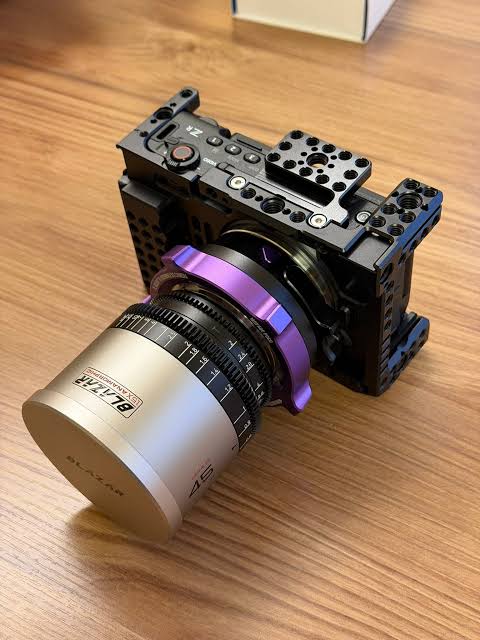
Nikon ZR rigged with a Blazar Remus 45mm. Photo: Royden Wakefield
The Nikon ZR was developed with RED and launched at $2,199 for the body. It records 12-bit RAW internally in three formats: RED’s R3D NE, Nikon’s N-RAW and ProRes RAW. The Sony FX3, by comparison, costs more and records 10-bit Log internally.
I own a Nikon ZR and offer it as part of my camera packages in Dubai. This article explains how its codecs are organised, because that part of the camera is often misunderstood. It also covers rigging for cinema work. The cage and accessory sections draw on field reviews published by The Savage Filmmaker and Matt Irwin Photography, and each source is credited where it is used.
A Brass Nikon ZR for Jason Momoa
Nikon USA presented the actor and director Jason Momoa with two custom all-brass Nikon ZR bodies. The back of each screen is etched with the compass design from his forearm tattoo. Tilta built a matching solid-brass cage.
According to Digital Camera World, Momoa will use the cameras on the next season of his HBO Max documentary series, On the Roam. He has worked with RED cinema cameras for years, so the choice also shows confidence in how the ZR performs next to larger RED bodies.
How the ZR Codecs Are Organised
Some shooters who move from Sony bodies such as the FX3 or FX6 criticise the 10-bit H.265 Log mode on the ZR for its heavy compression. On those Sony cameras, 10-bit 4:2:2 XAVC is the highest internal format. It is therefore natural to judge the H.265 Log of the ZR in the same way, although the Nikon is organised differently.
The grading formats on the ZR are the 12-bit RAW options. N-RAW is offered at two quality levels, High Quality and Standard, and R3D NE and ProRes RAW are also available. H.265 Log was designed to produce small files for quick-turnaround jobs where heavy grading is not needed. A 10-bit ProRes 422 HQ option sits between the two.
Two limits are worth knowing. 6K recording works only in the RAW formats, and ProRes RAW is not available at the fastest resolution and frame rate combinations.
File Sizes: 10-Bit Log Against 12-Bit RAW
Storage is the usual reason given for avoiding RAW. The difference is smaller than many shooters expect. The table compares the top internal 4K Log format of the Sony FX3 with the lighter N-RAW Standard setting on the ZR; the N-RAW figure comes from testing by Matt Irwin Photography.
| Camera and codec | Bit depth | Storage per hour (4K) |
|---|---|---|
| Sony FX3, XAVC S-I 4:2:2 Log at 240 Mbps | 10-bit Log | ~108 GB |
| Nikon ZR, 4K N-RAW Standard (APS-C, pixel for pixel) | 12-bit RAW | ~148 GB |
N-RAW Standard needs roughly 37% more storage. In return, white balance and ISO can be changed in post without loss, and there is far more exposure latitude in the grade.
The ZR records to CFexpress Type B cards, which usually cost less per gigabyte than the CFexpress Type A cards used by Sony. Its second slot takes microSD cards, but that slot is limited to slower UHS-I speeds. At about 148 GB per hour, a 1 TB card holds almost seven hours of 4K N-RAW Standard.
To summarise, if the compression of H.265 Log is a concern, 4K N-RAW Standard is the better choice for any footage that will be graded.
Firmware 2.00
Nikon has announced firmware version 2.00 for the ZR, scheduled for release before the end of 2026. The update adds Log3G10 and REDWideGamutRGB to H.265 recording, which should make the compact H.265 files far more suitable for grading. Focus peaking during R3D NE recording is also included, together with LUT output over HDMI.
Once the firmware is available, I will test Log3G10 H.265 against 4K N-RAW Standard on the same scene and share the results on this blog.
The XLCS Designs Cage
The ZR has a compact box body and no built-in EVF, so most users add a cage before cinema work. The Savage Filmmaker reviewed the XLCS Designs cage in detail. XLCS sells it in two versions: a NATO version at $199.99 and a top-plate version at $224.99. The points below summarise that review.
- Construction: The cage is machined from a single block of aluminium and weighs about 400 g. A sculpted thumb rest on the right-hand grip helps with handheld work.
- HDMI lock: The micro-HDMI port on the ZR is fragile. A two-stage lock converts it to a full-size HDMI output, and both the cable and the adapter are fixed to the cage.
- 15mm rod mounts: Rod mounting points are built into the top, bottom and rear of the cage. Locating pins and Allen bolts stop the rods from twisting, so no separate baseplate is required.
- Lens adapter support: A front support bolts to PL-to-Z adapters such as the Mofage POCO with drop-in variable ND. This removes mount play when heavy cinema glass is used.
The review describes three configurations. In a studio build, rods on top carry a DJI Focus Pro LiDAR unit and motor above the lens, which gives manual cinema primes reliable autofocus. The base then stays free for a V-mount cine baseplate or a DJI RS4 Pro gimbal.
A compact handheld version uses short rear rods for a mini V-mount battery, with a NATO handle on the side. For travel, a single bottom rod holds a small follow focus, and one manual prime keeps the camera light.
The XLCS cage is heavier and more expensive than minimal cages such as the SmallRig. Its built-in rod mounts, however, replace several separate brackets.
Field Accessories
Matt Irwin Photography recommends several low-cost accessories for everyday work with the ZR:
- SmallRig Gen 2 HDMI adapter (about $20–$25): Designed for the SmallRig cage, it screws into the cage and locks into the HDMI port of the camera. No cable hangs loose, and the USB-C port next to it stays clear.
- SmallRig hot-shoe windscreen (about $10–$15): This furry cover slides into the hot shoe over the built-in microphones and reduces wind noise outdoors. The ZR is the first mirrorless camera to record 32-bit float audio internally, so clean scratch audio from the camera is genuinely useful.
- Four-bay battery charger (about $35): The ZR runs on EN-EL15c batteries. A serial charger takes four at once and charges them in sequence overnight.
- “The Sack” camera support: This Australian beanbag-style support has an integrated neck strap. The camera can rest on rough ground or a railing for a low angle without a tripod, and the bag also braces the camera at waist height during long handheld takes.
Final Thoughts
The Nikon ZR makes 12-bit RAW practical for everyday work at a low price. With a suitable cage and a few accessories, the same body can serve as a light travel camera. Fully rigged, it also works as a B-cam on larger productions.
If you would like the Nikon ZR on your next shoot in Dubai or the UAE, see my equipment list or contact me.