By Atif Balouch, director of photography, Dubai
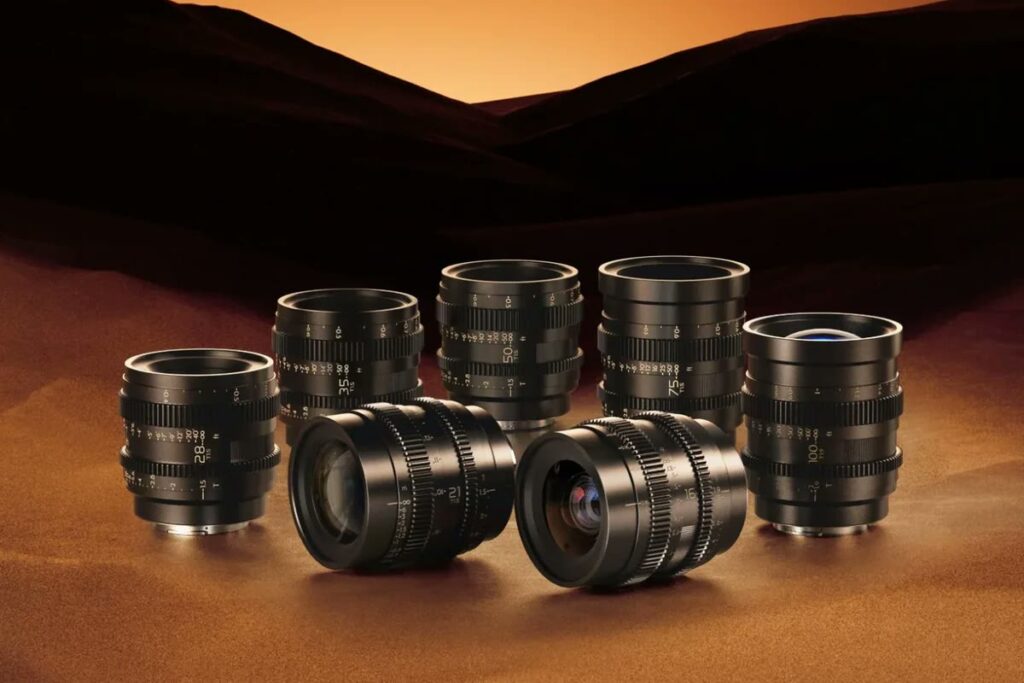
Thypoch Simera-C cine prime lineup. Image: Thypoch
The Thypoch Simera-C is a set of compact full-frame cinema primes. The Leica M-mount version is built around a 27.8mm flange distance, which allows the lenses to be adapted to most mirrorless and cinema camera mounts. With the 16mm T1.9 and the 100mm T1.9 now released, the M-mount lineup has seven focal lengths: 16, 21, 28, 35, 50, 75 and 100mm.
I shot with the Simera-C on a recent job in Dubai, using the five T1.5 lenses from the set: the 21mm, 28mm, 35mm, 50mm and 75mm. The lenses belonged to the director of the project. This review is therefore written from the camera operator’s position, and the specifications come from Thypoch’s published figures.
Why the Leica M-Mount Version Is Useful
PL-mount cinema lenses are designed around a 52mm flange distance, and their barrels are long and heavy as a result. The 27.8mm Leica M flange distance gives the Simera-C two practical advantages.
- Adaptability: The lenses fit Leica M bodies directly. With thin mechanical adapters, the same set also works on Nikon Z, Canon RF, Sony E, L-Mount and Fujifilm X cameras. The DJI Ronin 4D accepts them through its M-mount module, and RED Komodo or V-Raptor bodies can use them with an RF adapter.
- Size and weight: According to Thypoch, each M-mount lens is roughly 10mm shorter and 20–30 g lighter than the equivalent mirrorless-mount version. Weights range from 353 g to 472 g. On a Ronin 4D or a mirrorless gimbal, the set balances easily.
Adapter quality matters. A precision-machined adapter from a maker such as Fotodiox or Metabones is the safer choice on RF, Z or E-mount bodies.
Specifications of the Seven M-Mount Lenses
Every lens covers a 43.2mm full-frame image circle and has a 16-blade iris. The all-metal barrels are dust and splash resistant. Focus scales are marked in metric and imperial units, and the focus and iris rings carry standard 0.8 MOD gears with a 210-degree focus throw.
| Focal length | Aperture | Minimum focus | Length | Weight | Filter thread |
|---|---|---|---|---|---|
| 16mm | T1.9–T16 | 0.16 m | 69.6 mm | 467 g | M62 |
| 21mm | T1.5–T16 | 0.23 m | 68.8 mm | 472 g | M62 |
| 28mm | T1.5–T16 | 0.40 m | 59.8 mm | 377 g | M62 |
| 35mm | T1.5–T16 | 0.45 m | 59.8 mm | 381 g | M62 |
| 50mm | T1.5–T16 | 0.45 m | 59.8 mm | 353 g | M62 |
| 75mm | T1.5–T16 | 0.55 m | 76.6 mm | 435 g | M67 |
| 100mm | T1.9–T16 | 0.85 m | 76.6 mm | 451 g | M67 |
The 28mm, 35mm and 50mm share the same 59.8mm length and gear position. A follow focus or LiDAR unit therefore stays in place when these lenses are changed.
Optical Character
The design draws on Thypoch’s rangefinder lenses and uses aspherical, extra-low dispersion and high-refractive elements. The result is a modern vintage look. Images are clean in the centre, while the edges keep some softness.
- Sharpness and chromatic aberration: At T1.5 the centre is sharp and the corners fall off gently. Slight pink and green fringing can appear during focus pulls. Contrast improves at T2 to T2.8, and from T4 to T5.6 the whole frame is evenly sharp.
- The 21mm T1.5: A T1.5 aperture is rare in a 21mm lens of this size. Published tests rate it as one of the cleanest lenses in the set, with low chromatic aberration wide open and little distortion. It also focuses to 23 cm and shows the least focus breathing of the lineup.
- Bokeh: When the iris is closed slightly, the 16 blades keep specular highlights round. Wide open, highlights near the edges take on a cat’s-eye shape with a slight swirl, which is most visible on the 50mm and 75mm.
- Close focus: Traditional rangefinder M lenses often stop at around 70 cm. A floating element design allows the Simera-C 75mm to focus at 55 cm, and the 35mm and 50mm reach 45 cm.
Trade-Offs
- Focus breathing: The 21mm controls breathing well and the 35mm shows a moderate amount. On the 28mm, 50mm and 75mm, breathing is noticeable during fast rack focus pulls.
- Two filter sizes: The 16mm to 50mm use a 62mm filter thread, whereas the 75mm and 100mm use 67mm. A 62mm-to-67mm step-up ring is useful for screw-on filters, or a matte box can be used across the set.
- No electronic contacts: The lenses are fully manual. Focal length and aperture data are not sent to the camera, so lens metadata has to be logged by hand.
Availability
All seven focal lengths are sold individually, and Thypoch also offers multi-lens kits in hard cases. The 100mm was announced in October 2026 at a suggested price of US$959 for the M-mount version. Kit contents and regional stock vary, so it is worth checking with an authorised Thypoch dealer before planning a purchase.
Verdict
The M-mount Simera-C is a light, fast prime set that is not tied to one camera brand. Its 210-degree focus mechanics feel like those of larger cinema lenses. The look is modern, although it keeps a degree of vintage character, and the same set can move between Nikon Z, Sony, Canon RF and L-mount bodies. It can also be used on RED cameras and the DJI Ronin 4D.
Planning a shoot in Dubai or the UAE? I work as a director of photography and camera operator with my own camera packages, and I am comfortable shooting on the production’s preferred lenses. See my equipment list or contact me.